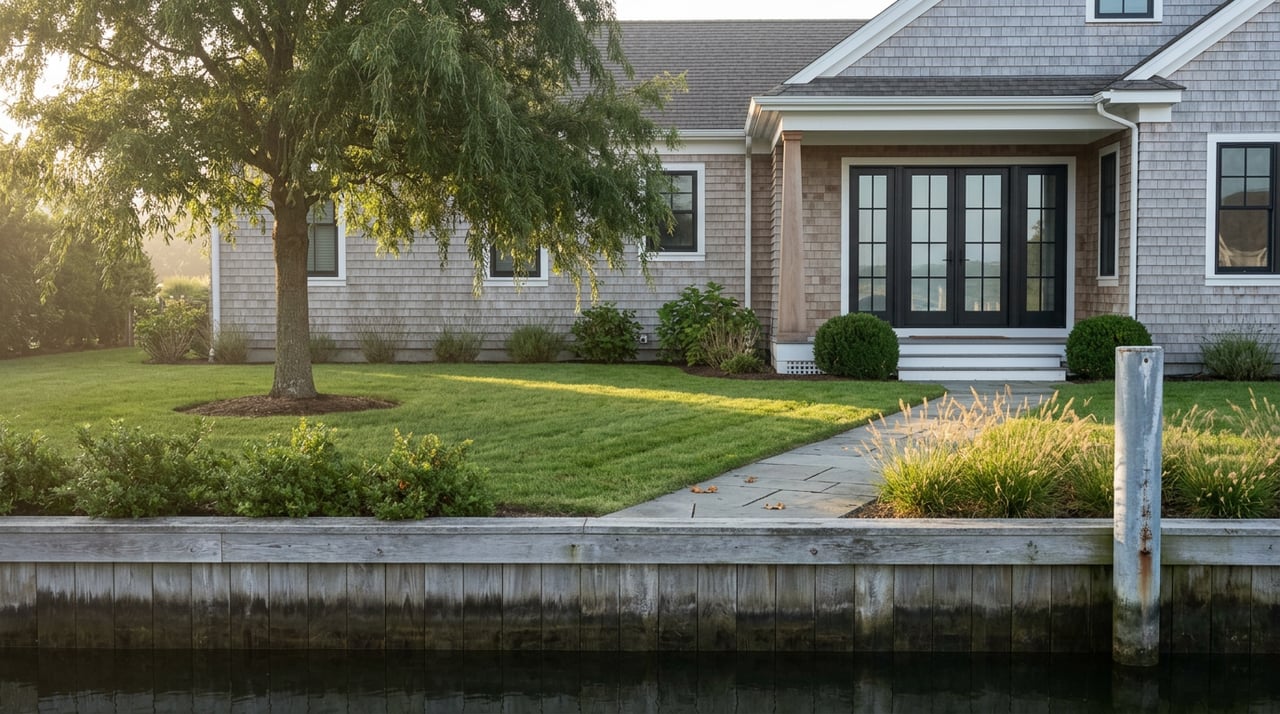
Selling on a Bay Shore Canal? The Bulkhead Decides the Deal Before the Kitchen Does
September 3, 2026
September 3, 2026
A listing for a home on Awixa Avenue advertises 250 feet of bulkhead the way another listing might advertise a chef's kitchen. Another, a few doors down in the same Bay Shore canal enclave, calls out "500 Linear Feet Of Bulkhead With A 45 x 17 Boat Slip" before it even gets to the square footage. A third, in the gated Moorings community off Awixa Creek, leads with 200 feet of bulkhead and a boat lift.
Sellers in these enclaves have learned to treat linear feet of bulkhead as a selling point, right up there with a renovated kitchen or a finished basement. What most of them have not fully priced in is that a bulkhead is not a feature. It is a permitted structure sitting on land the seller usually does not own outright, subject to a municipal code most homeowners have never read and, in some cases, a state environmental review most buyers' attorneys will ask about before they let a contract move forward. In Bay Shore's waterfront pockets, that wall is often the actual subject of negotiation. The kitchen just gets photographed first.
Bay Shore's canal geography is not one undifferentiated stretch of water. It's a set of named, distinct enclaves that each show up repeatedly in local listings: Awixa Creek Estates, the Penataquit Point peninsula off the Great South Bay, the historic Bayberry Point association built out around 1900 by Henry Havemeyer, the gated Moorings community, and canal-front streets tied to Orowoc Creek. Even the Lawrence Canal, running through the Oconee Estate section, has its own waterfront lore, including the old Hoffritz Cutlery estate with nearly 700 feet of canal frontage.
Every one of those addresses has the same underlying legal fact hiding behind the water view: the canal bed the bulkhead sits on or touches is typically owned by the Town of Islip, not the homeowner. The upland owner uses it privately, without a lease, under a specific set of town rules. Selling one of these homes means selling a house that sits at the edge of municipal jurisdiction, whether the listing photos mention it or not.
The Town of Islip's Navigation Law, part of the town code, spells out what upland owners are allowed to do to a bulkhead that touches town-owned canal, stream, or bay bottom. The plainest version of the rule: a one-time replacement of an existing bulkhead, or a one-time resheathing, is a permitted activity as long as the new work stays within 18 inches waterward of what's already there. It comes with a fee tied to the Planning Division's schedule rather than a full development review. That is the version most sellers hope they are dealing with.
The same code section also caps how far a dock or pier can extend into a canal. No encroachment, dock included, can occupy more than a quarter of the waterway's width. On the narrower canals off Awixa Creek, where boat lifts and cut-in slips are common selling points, that quarter-width limit is the quiet reason some of the more elaborate dock setups you see in listing photos were only ever approved because the canal happened to be wide enough to allow it.
None of this is exotic. It's public code, and any title search or municipal records request on one of these properties will eventually surface it. The problem is timing. Sellers who find out about the permit history for the first time during attorney review are the ones who watch a signed contract stall.
A one-time resheathing within that 18-inch limit is one thing. A bulkhead that has failed enough to need full removal and reconstruction, or one where a homeowner wants the new wall higher or in a different alignment, moves into a different lane entirely: state environmental review through the Department of Environmental Conservation.
A real filing from an Orowoc Creek property in Islip shows what that process actually asks for. The application proposed removing a lawfully existing bulkhead and rebuilding it in three separate runs totaling 255 linear feet, with the new wall set 18 inches higher than the old one, built to a Navy-style specification, and paired with a maintenance dredge of roughly 25 cubic yards along the new face. The public comment period on that project ran into December 2023. That is not a same-week approval. It's an engineered project with a paper trail, and it's the kind of project a buyer's attorney will specifically ask whether a seller has already completed, has permits pending on, or has never addressed at all.
Here's the difference in plain terms:
| One-time resheathing or replacement | Full bulkhead reconstruction | |
|---|---|---|
| How far it can move | Within 18 inches waterward of the existing wall | Any new footprint, height, or alignment |
| Who has to sign off | Town of Islip Planning Division, fee-based permit | Town of Islip plus NYSDEC review, with a public comment period |
| What it usually means mid-contract | Often already documented by a prior owner, faster to verify | Can still be in review or unresolved when a home goes under contract |
A seller who can hand a buyer's attorney a closed permit file is negotiating from a completely different position than one who can only say the wall "looks fine."
Bulkhead replacement on Long Island waterfront property runs roughly $800 to $1,500 per linear foot for timber construction, before engineering, permitting, and dredging are added in. Vinyl sheet pile costs more up front but lasts longer.
Run that math against what's actually advertised in Bay Shore listings and the stakes get concrete fast. A modest 75-foot bulkhead, common on the smaller canal lots, sits in the range of $60,000 to over $110,000 to replace at today's per-foot pricing, before permits. A 250-foot bulkhead like the one on Awixa Avenue could run well past $200,000. The 500-foot wall on the property nicknamed "Awixa Castle" is a different order of liability entirely if it ever needs full reconstruction rather than a one-time resheathing.
This is the number buyers and their attorneys are trying to get a handle on when they ask for bulkhead documentation. A seller who has not had the wall looked at by a marine contractor or engineer is asking a buyer to underwrite an unknown five- or six-figure cost sight unseen. Buyers increasingly won't do that quietly. They'll come back with a credit request, a price reduction, or a walk.
If your Bay Shore home sits on a canal in Awixa Creek Estates, Penataquit Point, Bayberry Point, along the Lawrence Canal, or anywhere else with a bulkhead in the yard, the work worth doing before you list isn't staging the dock. It's building the file.
Start with what the Town of Islip Building Division has on record for the property. If a prior owner did a one-time resheathing, that permit should exist. If the wall has never been touched since original construction, get a marine contractor or licensed engineer to look at it separately from your general home inspection, the same way you'd get a chimney specialist to look at a fireplace a general inspector can only glance at. If a full bulkhead reconstruction is genuinely needed, get ahead of the DEC timeline rather than discovering it during attorney review with a buyer already under contract.
Pricing a waterfront listing without factoring in bulkhead condition is pricing it on incomplete information, and that gap tends to surface at the worst possible point in a transaction: after an accepted offer, during due diligence, when both sides have the least room to negotiate calmly. A current home valuation that accounts for waterfront condition, not just waterfront frontage, gives you a number you can actually defend when a buyer's attorney starts asking questions.
Does every canal-front home in Bay Shore have this issue? Only homes with an actual bulkhead, which is most of them in enclaves like Awixa Creek Estates and Penataquit Point, but not every waterfront lot. Some properties front open bay or beach without a bulkhead structure at all, which changes the permitting picture entirely.
Can I still sell if my bulkhead needs work? Yes. Homes sell with known bulkhead issues regularly. What changes is the negotiation: expect a credit request, a price adjustment, or a request to complete repairs before closing, depending on what your contract and attorney work out.
Who typically pays for bulkhead repair, buyer or seller? That's a point of negotiation between the parties and their attorneys on each individual contract, not something set by town code. Getting your documentation together before you list gives you a stronger starting position either way.
If you're weighing a sale on one of Bay Shore's canals, or you're comparing a canal-front purchase against an inland one, a conversation early beats a surprise late. Annette Mina has spent years walking Bay Shore's waterfront blocks with buyers and sellers who needed a straight answer on exactly this kind of question. Let's Connect before you list, so nothing about your bulkhead becomes news to you at the closing table.
Stay up to date on the latest real estate trends.
With decades of experience, trusted market expertise, and a client-first approach, Annette Mina is dedicated to your success every step of the way.